


Johnson Recesses House to Duck Hegseth Impeachment Vote
GOP House Speaker Mike Johnson (R-La.) has punted the impeachment of Defense Secretary Pete Hegseth to a time after the midterm elections.
The reason: Johnson knew some Republicans would feel compelled to vote for sacking the imperious Trump official, who found himself in the sights of outgoing Republican Representative Thomas Massie of Kentucky.
Massie announced two days ago that he would force a vote on eight articles of impeachment. His grounds were Hegseth’s involvement in the unconstitutional war against Iran, the arrest of Venezuelan strongman Nicolás Maduro, and other high crimes and misdemeanors.
One problem for Johnson: If the GOP loses control of the House, Democrats might well be happy to pass Massie’s bill. That would send Hegseth to the U.S. Senate for trial.
Massie’s Articles of Impeachment
As The New American reported on Tuesday, Article I of the 34-page resolution alleges that Hegseth “directed and caused United States Armed Forces to be introduced into hostilities” with Iran, even though Congress “had not declared war.” Nor had Congress “enacted any specific statutory authorization” for the war.
Articles I through III are related to Hegseth’s repeated violations of the War Powers Resolution of 1974. Article IV accuses him of “ignoring laws that minimize civilian casualties” and murdering civilians.” It points to the Tomahawk cruise missile strike on a girls’ school. The article also says Hegseth crippled the Pentagon’s ability to track civilian casualties.
Article V cites Hegseth’s involvement in attacks on drug boats in the Caribbean Sea and Eastern Pacific Ocean that have killed 221 people.
Hegseth trespassed the free speech rights of Democratic Senator Mark Kelly of Arizona when the Pentagon investigated the former fighter pilot after he reminded service members they are not obligated to obey illegal orders, Article VI alleges.
Article VII alleges that Hegseth was involved in illegally kidnapping Maduro, and Article VIII says he helped wage an illegal war against Yemen.
Johnson Chickens Out
Massie’s use of a House privilege required a vote on the resolution within two days. Johnson panicked.
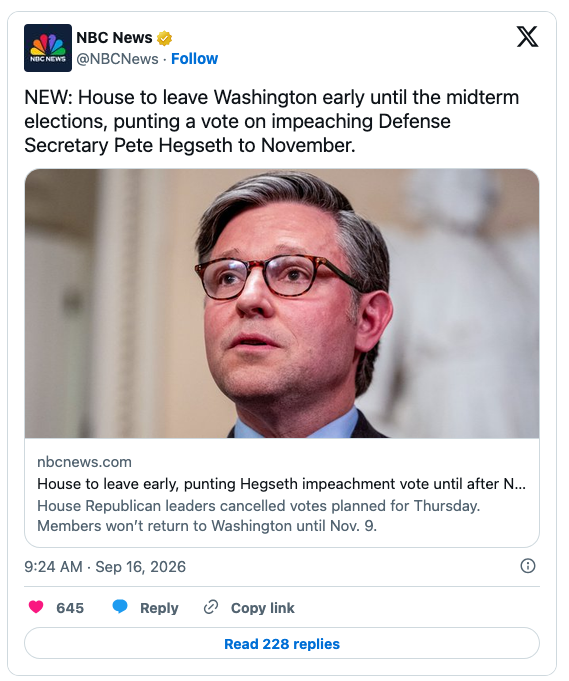
“House members will leave Washington on Wednesday night for the last time before the November midterm elections, after GOP leaders said they were canceling votes set for Thursday,” NBC News reported:
The change in schedule means that the House won’t vote on Republican Rep. Thomas Massie of Kentucky’s resolution to impeach Defense Secretary Pete Hegseth until after Election Day.
GOP leaders insisted their decision had nothing to do with Massie’s impeachment efforts. But they were eager to avoid a difficult vote for many of their vulnerable Republican members who have been uneasy with Hegseth’s leadership during the unpopular six-month war with Iran.
Of course Johnson, President Donald Trump’s yes man on Capitol Hill, claimed that Massie’s bill is “ridiculous,” the network reported.
“It’s a publicity stunt by someone who wants attention. It will immediately be tabled, of course. … We’ll probably do it when we come back, but it’s a stunt,” Johnson told reporters.
The speaker thinks Hegseth “has done an extraordinary job…. We’re in the middle of international conflicts right now, and we should not be playing games with national security.”
So now the House can’t vote on the measure until members return to Washington, D.C., after the midterms, when they’ll try to squeeze some governing into their busy schedule of boozing and debauchery.
Massie told far-left CNN hostess Kaitlan Collins that Johnson was practicing “bad politics” by leaving “this impeachment hanging over Pete Hegseth’s head for eight weeks.”
“And if there was any other reason that they canceled tomorrow’s … session, they could have had the Hegseth vote tonight,” Massie told Collins:
Because the rules say that he has to have the vote within 48 hours. They don’t … say he has to wait 48 hours. So he could have had the vote yesterday as soon as I introduced the articles. He could have done it today before he adjourned Congress.
Not voting on the measure “tells me that they did a whip check, and they probably found that there were some other Republicans besides me that were going to vote for this,” Massie said, “or [who] at least didn’t want to be on the record supporting Hegseth.”
What Happens in November
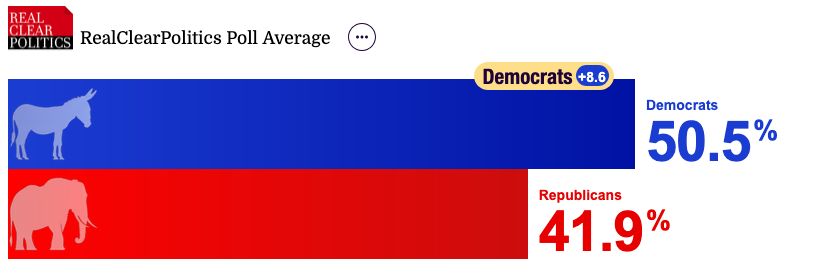
NBC noted that Johnson must hold onto to his “razor-thin GOP majority,” a tough task given the low poll ratings for Trump and the party. The RealClearPolitics average of polls on the generic congressional vote puts Democrats at 50.5 percent against the GOP’s 41.9 percent.
Democrats have targeted Hegseth for removal as well.
“A group of nine Democrats, led by Rep. Yassamin Ansari (D-Ariz.), introduced an impeachment resolution in April against Hegseth,” Politico observed:
They accused him of prosecuting an unauthorized war in Iran, targeting civilians and mishandling classified information, among other charges. But Massie’s move is a first-of-its kind effort to go after a Cabinet member in the same party.

Should Democrats take the House, Hegseth might be doomed.
“The looming impeachment vote presents a political conundrum for Democrats, many of whom are open to Hegseth’s ouster if they win control of the House in November,” the website reported:
But those lawmakers argue any impeachment must be the result of careful investigative work by the committee with oversight of the Pentagon.