
Election 2012: Changing Demographics
On Sunday before Election Day, the Pew Research Center released its final prediction on the outcome of the election: President Obama would win, beating Republican Party candidate Mitt Romney, 50 percent to 47 percent. When all votes were tallied, Obama beat Romney, 50.6 percent to 47.8 percent.
Pew acknowledged that the president’s virtual takeover of the media in the aftermath of Hurricane Sandy just before the election persuaded some who were undecided to vote for the president. According to Pew:
Obama’s handling of the storm’s aftermath may have contributed to his improved showing. Fully 69% of all likely voters approve of the way Obama is handling the storm’s impact.
Even a plurality of Romney supporters (46%) approve of Obama’s handling of the situation; more important, so too do 63% of swing voters.
In its final pre-election survey of 2,709 voters conducted from October 31 through November 3, Pew began to see how the electorate was moving. Thirty-nine percent of likely voters supported Obama strongly, whereas just a third of them strongly supported Romney. Noted Pew: “In past elections … the candidate with the higher percentage of strong support has usually gone on to win the popular vote.”
Among women voters, Pew noted the most dramatic shift towards Obama, favoring him 53 percent to just 40 percent for Romney — a 13-point margin and a six-point improvement from just a week before.
Meanwhile, Pew noted that among voters age 65 and older, Romney’s support began to fade down the home stretch. Romney’s 19-point lead in Pew’s previous poll had declined to just nine points in the latest one.
On Wednesday, November 7, Pew released its post-election analysis and noted that its prediction was spot-on, with women, young people, and minorities breaking strongly for Obama, overcoming the advantage Romney held among older white voters. Here’s how Pew described the shift:
Nationally, nonwhite voters made up 28% of all voters, up from 26% in 2008. Obama won 80% of these voters, the same as four years ago.
Obama’s support from nonwhites was a critical factor in battleground states, especially Ohio and Florida. In Ohio, blacks were 15% of the electorate, up from 11% in 2008. In Florida, Hispanics were 17% of the electorate, a slight increase from 14% in 2008.
While minority compositional gains were not huge, they offset a strong tilt against Obama among white voters. Nationally, Romney won the white vote, 59% to 39%.
Although Obama nominally lost the independent vote, 50 percent to 45 percent, the number of Democrats (making up 38 percent of all voters) overwhelmed the Republicans (who made up just 32 percent of all voters). Pew called it a “demographic transformation”:
Evidence of the demographic transformation of the electorate is seen in the profiles of each candidate’s supporters: Fully 89% of Romney’s were white non-Hispanics, compared with just 56% of Obama’s supporters. Romney managed to better McCain’s showing among whites by four percentage points — and still lost the election.
The message from the Obama campaign that most of the causes of the Great Recession could be laid at the feet of President George W. Bush still continued to resonate with voters, with voters blaming him and not the current president for the recession by 53 percent to 38 percent. And although many forecasters considered the poor economy as a liability for the president’s reelection chances, those who stated that their financial situation hadn’t changed under Obama’s first term still voted for him by a wide margin: 58 percent to 40 percent.
Laurie Goodstein, writing in The New York Times, noted another demographic that worked in Obama’s favor: the failure of the so-called “Christian Right” to overcome the demographic shift even with a highly energetic campaign in favor of Romney. In an interview, R. Albert Mohler, president of the Southern Baptist Theological Seminary, said:
It’s not that our message — we think abortion is wrong, we think same-sex marriage is wrong — didn’t get out. It did get out.
It’s that the entire moral landscape has changed. An increasingly secularized America understands our positions, and has rejected them.
Such a strong showing by Obama in the election signifies a shift that cannot be denied, according to Robert P. Jones, head of left-of-center Public Religion Research Institute, who said,
This election signaled the last [one] where a white Christian strategy is workable. Barack Obama’s coalition was less than 4 in 10 white Christian. He made up for that with not only overwhelming support from the African-American and Latino community, but also with the support of the religiously unaffiliated.
It’s those with no religious affiliation who really put the president back into the White House. According to Pew, 20 percent — nearly one-fifth of the population — have no religious affiliation, while one-third of Americans aged 18-22 call themselves atheists, agnostics, or nothing at all — what pollsters call the “nones.” Seventy percent of the “nones” voted for Obama.
Future elections will no doubt increasingly be decided by women, young people, and minorities, as the greying, over-age-65 voters diminish in numbers and influence.
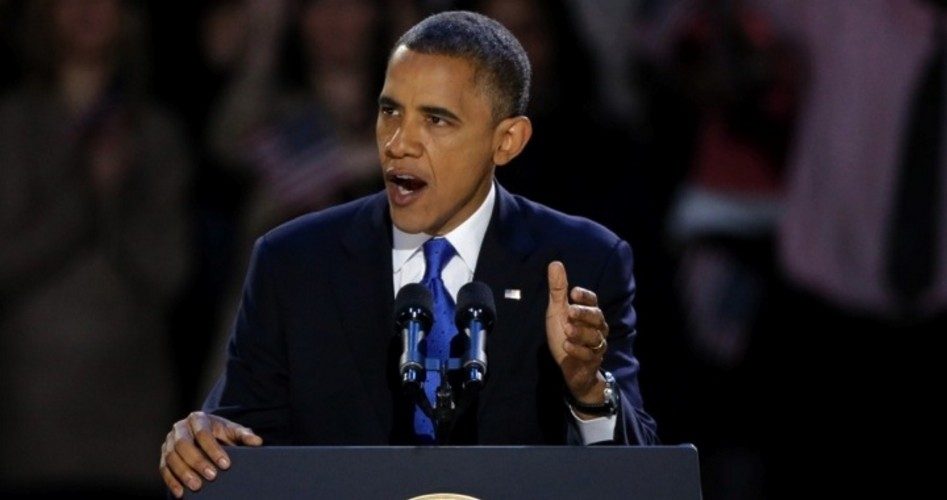
Photo of President Barack Obama: AP Images