
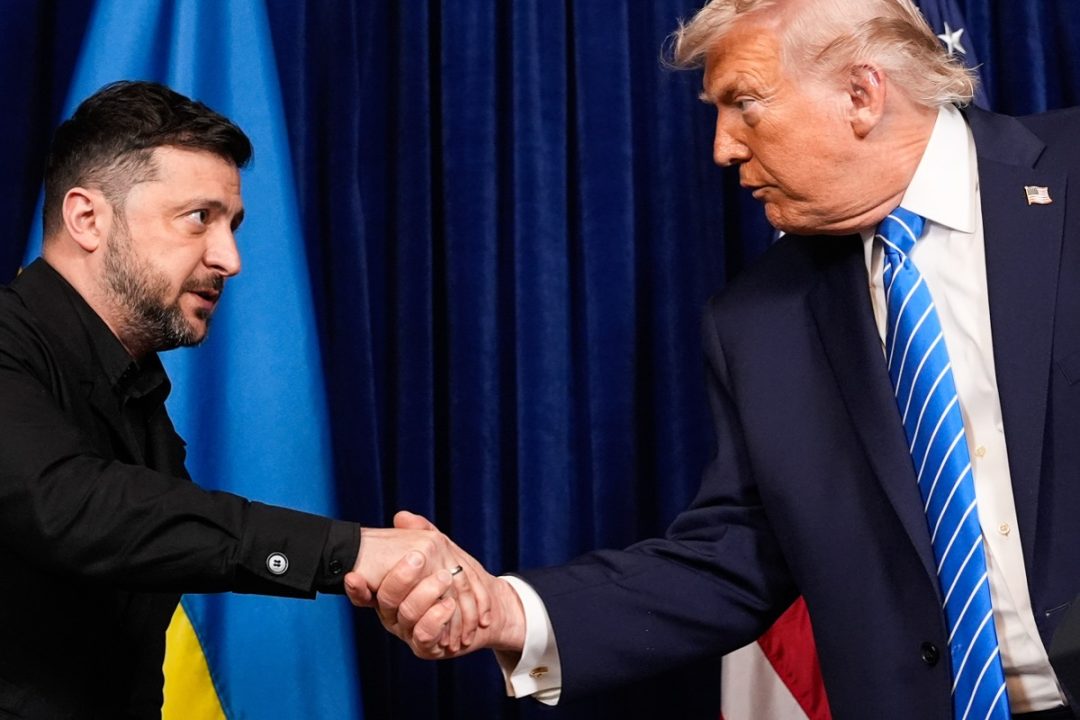
Is the Trump-Zelensky Rift Misleading?
Ukrainian leader Volodymyr Zelensky has spent all week telling Western media how disappointed he is with U.S. President Donald Trump. He recently lamented what he claims is Ukraine losing American support in its war with Russia. But what are the real chances the United States will pull back support for Ukraine, and who really makes those decisions, anyway?
“It’s a pity we are losing a strong partner,” Zelensky told Piers Morgan this week. He said that recent decisions by the Americans, particularly Trump’s diesel deal with Russia and an interruption in Starlink communications for the Ukrainian military, felt like a betrayal.
Musk’s Involvement
During that interview, Zelensky pled with Elon Musk to reboot the military version of Starlink, called Starshield, to full power so Ukraine could carry out attacks and shoot down Russian drones. Between Tuesday and Wednesday, Ukraine suddenly experienced speed restrictions in the Starshield network. Musk said he had nothing to do with that. He said he didn’t control or own Starshield, and instead passed the buck to the White House, explaining in a social media post on Wednesday:
Starshield systems are owned and controlled by the US government. Any limits on speed or usage are decided by the US military and ultimately POTUS.
Musk has never been a fan of this war, and has advocated peace talks to end it since the beginning. In 2023, in an interview with podcaster Lex Fridman, he compared the Ukraine war to World War I, in which “young men who don’t know each other are sent to kill each other by old men who do know each other.” On Wednesday, Musk reiterated his disapproval of the war and Zelensky. “And so the slaughter continues,” he said on social media. “Time for Zelensky to go.”
By Thursday, Starshield systems were fully restored, but it’s still not clear what caused the disruption. Some Ukrainian officials suspect the hiccup was no accident. Zelensky advisor Serhiy Beskrestnov said the communications problem was “related to the current political situation.”
Trump & Musk vs. Zelensky
That “current political situation” includes Trump and Musk casting Zelensky as the obstacle to a peace deal and a major reason for high fuel prices. Over the weekend, Trump announced an energy ceasefire between Russia and Ukraine. But there was no acknowledgment from either side they had agreed to such a deal. Zelensky immediately came out and said Russia knew nothing about this deal because it unleashed a barrage of strikes on Ukrainian power infrastructure. Angered that his decree was ignored, Trump called for Zelensky to be replaced. There were even threats that the U.S. would stop providing targeting intel to Ukraine, which appears to have momentarily happened.
By Wednesday, Ukraine, armed once again with American communications, was back to hitting Russian oil refineries (assuming claims that it temporarily ceased were true in the first place). Zelensky said he was “done” with Trump’s ceasefire.
Zelensky’s attacks on Trump this week were bold. In a recent interview with the Financial Times, he suggested that Trump admires rich autocrats. He said the American president has shown an affinity for leaders who can hold on to power for long periods of time, using Putin and Xi as examples. This is not completely untrue. The irony, however, is that Zelensky himself is in a position that expired more than two years ago. He’s been president of Ukraine for seven years, yet his term officially ended May 2024.
Ukraine has not held any elections since Russia invaded. It imposed martial law in 2022, and has used the war as an excuse to end elections, censor journalists, arrest Orthodox priests, and abolish a slew of opposition political parties. It looks like Ukraine is hardly different from the tyrannical society the Western world accuses Russia of being.
The Latest
The latest spat between Trump and Zelensky started after Trump announced this past weekend a deal for the United States to buy nearly five tons of diesel from the Russians. Understandably, Zelensky saw that as a direct benefit to Moscow, whose main source of revenue is energy. Some U.S. lawmakers doubt whether the deal is even legal, given the sanctions America has leveled on Moscow.
This isn’t the first time Ukraine has appeared to be on the verge of losing U.S. support. In addition to the famous February 2025 outburst in which Trump told Zelensky he doesn’t hold any cards, Trump has also called him a dictator. Trump has seesawed between the two leaders he sees as responsible for the continuance of this war.
Washington Continues Supporting Ukraine
Yet despite the litany of accusations and Trump’s bleeding-heart claims that he’d like to see the war end quick and soon, U.S. weapons and intel keep pouring in — far beyond what most Americans know about. Military analyst Jennifer Kavanagh wrote a detailed piece in September for Responsible Statecraft about how the U.S. is still sending weapons, made and paid for by America, to Ukraine. Kavanagh writes:
There are about $13 billion in outstanding [Ukraine Security Assistance Initiative, or USAI] contracts as of June 2026, down from $20 billion in January 2025. These contracts, signed by [former President Joe Biden] and now implemented by Trump, will procure weapons for Ukraine through about 2028. … These continuing deliveries are not new awards, but they are still taxpayer-funded military aid to Ukraine that will add up to about $20 billion in aid over the 4 years of Trump’s term. Weapons produced under these contracts come off overburdened U.S. production lines.
According to Kavanagh, the Trump administration doesn’t have to follow through on these contracts, but chooses to do so:
If the Trump administration were serious about ending U.S. spending on the Ukraine war, it could still recoup these funds and reallocate the money to support U.S. defense production needs. It has instead allowed the aid to continue.
And that’s not all. Hundreds of millions of dollars have flowed into Ukraine since Trump took office. “Congress included about $800 million of USAI funding in the 2026 and 2027 [National Defense Authorization Acts],” Kavanagh points out. Also, the State Department continues sending drones, armored vehicles, guns, grenade launchers, and other equipment through Ukraine’s Ministry of Interior:
The State Department has also approved $3 billion of new arms sales to Ukraine in 2025 and 2026 that will be at least partially funded from foreign military financing (FMF), which means U.S. dollars supporting foreign government purchases of U.S. weapons. Some of these funds may come from money allocated but not spent under President Biden, but much of the funding will be new, coming from the State Department’s budget.
But, as Kavanagh points out, this isn’t the most important assistance Ukraine receives. “The United States gives Ukraine real-time targeting information, including on the movement of Russian troops and the location of key command centers,” she writes. “This information has been important to Ukraine’s mid-range strike campaign on Russian logistics as well as its deep strikes against military and energy targets inside of Russia.” Between weapons, intelligence, and operational support, “U.S. taxpayers are still spending roughly $20 billion per year on Ukraine.”
Looks Like Theater
All this suggests three possible scenarios. The first is that Trump is too inept and chaotic to commit to an effective strategy to end the war. He has certainly exhibited a propensity for making decisions that contradict each other. A recent example is the decision to buy Russian diesel less than a month after signing a bill to sanction Russian energy. This scenario also assumes he truly wants to end the war.
A second option is that all the talk about wanting to end wars is a lie, theater written for voter consumption. That explains why he says one thing while Washington does another, providing the very lifelines that keep Ukraine in the fight. Without U.S. intel, Ukraine would be blinded and forced to agree to a peace deal. The war would end almost overnight. Yet the president refuses to use his power to put an end to this.
A third possibility is that Trump would like to do everything he can to end this war but simply doesn’t have the power to end full U.S. involvement. He’s done as much as he could, but he’s not in charge of the big decisions. He simply cannot force the intelligence community to stop supporting Ukraine.
Zelensky’s whining and Trump’s finger-pointing aside, there is nothing significant to suggest U.S. support for Ukraine has waned. As we just showed, and as the Ukrainians have acknowledged, the American communications system, the most important element to Ukraine’s military, is already back up and running at full speed. And, according to reports, Kiev has already used it to hit another Russian refinery.
In essence, what Trump and Zelensky say on TV appears to be nothing more than theater. The real moves are happening behind the stage.